

Volunteer Action at Lake Vrana
During the winter months, the wetlands along the shores of Lake Vrana become a refuge for numerous bird species that find food sources and resting places there. However, heavy traffic from the nearby local road often disturbs their stay. That is why last week we organized a volunteer planting action to create a green barrier in the Vransko jezero Nature Park, which will provide birds with additional protection from noise and traffic-related mortality.
A green barrier is a dense strip of vegetation that visually isolates an area, giving birds a greater sense of safety. A few years ago, we successfully carried out restoration activities on a wet grassland near the Crkvine information center, where volunteers and students helped plant shrub species. These activities proved to be very successful, so this year—through the Restoring Wetlands project, which aims to conserve wetland habitats—we decided to continue planting new vegetation near the information center.
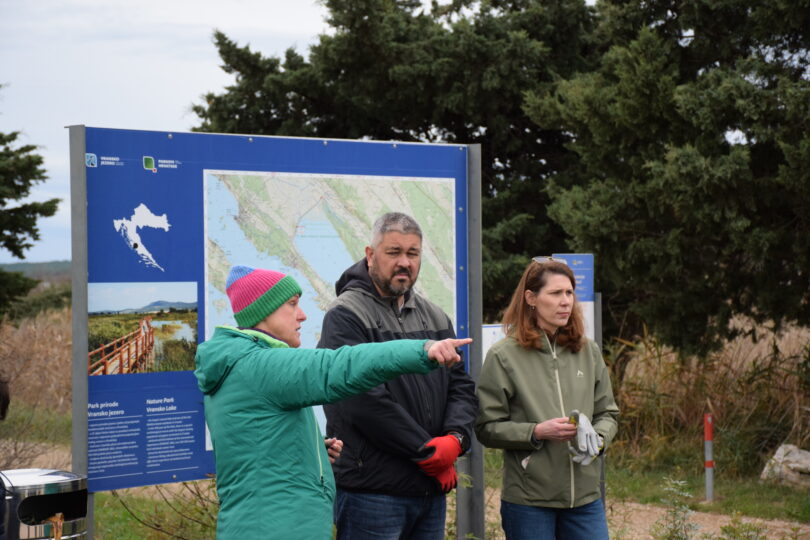
Despite the changeable weather forecast, around forty motivated volunteers took part in the new planting action, including students and teachers from Gračac Secondary School and Biograd na Moru Secondary School, BIOM volunteers, and volunteers from the European Solidarity Corps program “Solidarity for Natural Heritage.”
“We would like to thank all the volunteers for their valuable work. The task was far from easy—there was a lot of physical labor involved, requiring people to really roll up their sleeves, shovel, and fill in holes previously dug for the saplings. In a way, the action also had an international character, as dedicated European Solidarity Corps volunteers from Germany, Ireland, and France joined us. They are volunteering in Croatia for an entire month,” representatives of the Park said.
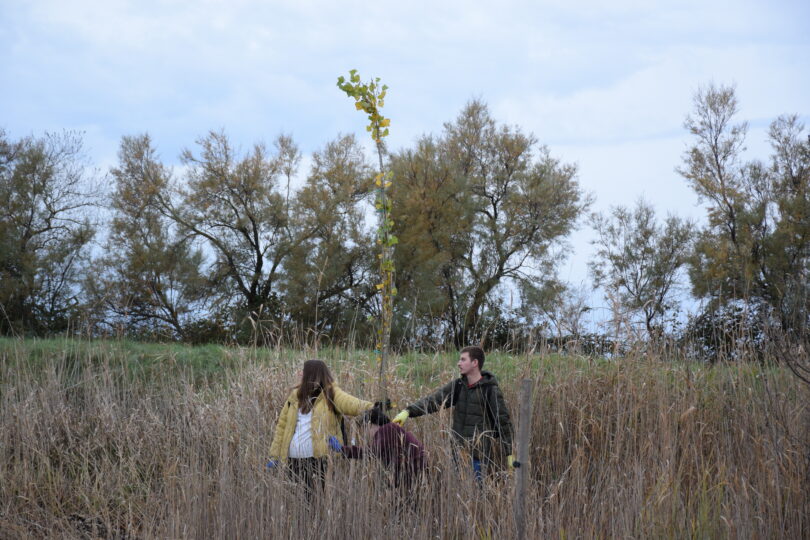
Several hours of fieldwork and a great atmosphere resulted in the planting of 60 carefully selected plants. A stretch of about 800 meters along the road has now been enriched with Chaste trees Vitex agnus-castus, Mastic tree Pistacia lentiscus, and Elm Ulmus sp. and Lombardy poplars Populus nigra ‘Italica’. Each of these species plays an important role in creating a dense protective barrier and adapts easily to local conditions. For example, the chaste tree grows as a large shrub and tolerates extreme conditions—from flooding to drought and salinity—better than most woody species. It also blooms for a long time, providing food for numerous insect species. The mastic tree is a Mediterranean evergreen shrub resistant to drought, which is why it was planted in rocky and drier micro-locations, and its fruits serve as food for birds. The elm is a typical tree of Mediterranean periodically flooded habitats and thrives in conditions where other trees cannot survive. The Lombardy poplars, a cultivated form of the black poplar, is a traditional element of the landscape and is important for forming tree lines that birds must fly over, thereby reducing mortality and the risk of collisions with vehicles on the road along the edge of the Nature Park.
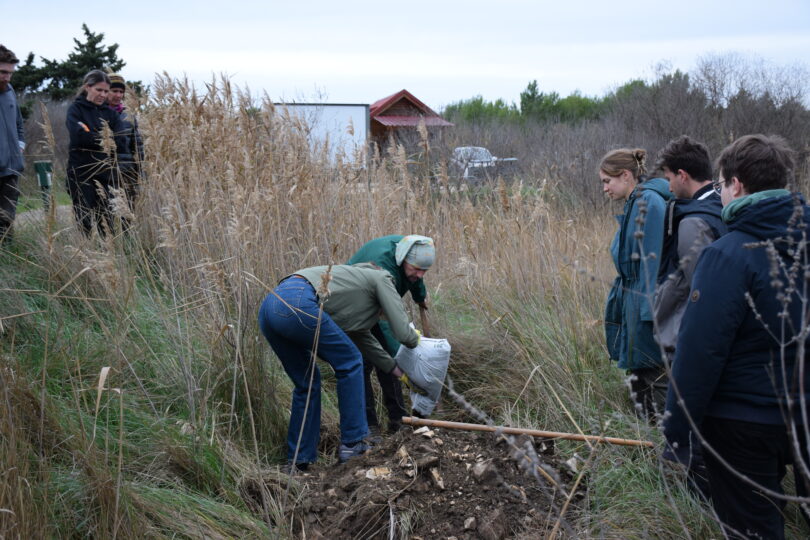
Volunteers planted all the vegetation within just a few hours, which proved ideal as it allowed us to avoid the heavy rain that followed. However, that rain later turned out to be a blessing, soaking the ground and increasing the chances that the newly planted saplings will successfully take root and be ready for the next summer and its drought conditions.
In addition to spending the end of the week in nature, the volunteers learned practical planting skills—from site selection and digging holes of appropriate depth to proper covering of the root ball with soil and ensuring additional food sources. For younger volunteers, transplanting larger trees such as poplars was particularly challenging and educational, as the saplings were over three meters tall and required greater coordination and care during handling.
“We are very satisfied with the volunteer turnout, and we would especially like to thank the high school students and their teachers, who accepted our invitation wholeheartedly. Although the rain prevented us from planting the planned additional 100 saplings, we still did an excellent job! We believe the Park will soon find an opportunity for another planting action so that the entire roadside belt will be ready for the coming seasons,” BIOM representatives stated.
This action once again demonstrates how the local community, educational institutions, and volunteer forces can work together to create positive change for nature. Every newly planted stem will undoubtedly play an important role in the conservation of the birds of Lake Vrana.