

To celebrate the International Year of Rangelands and Pastoralists (IYRP), Biom Association, in cooperation with the Global Alliance for Rangelands and Pastoralists, organised a webinar dedicated to the future of transhumance and the conservation of Mediterranean landscapes.
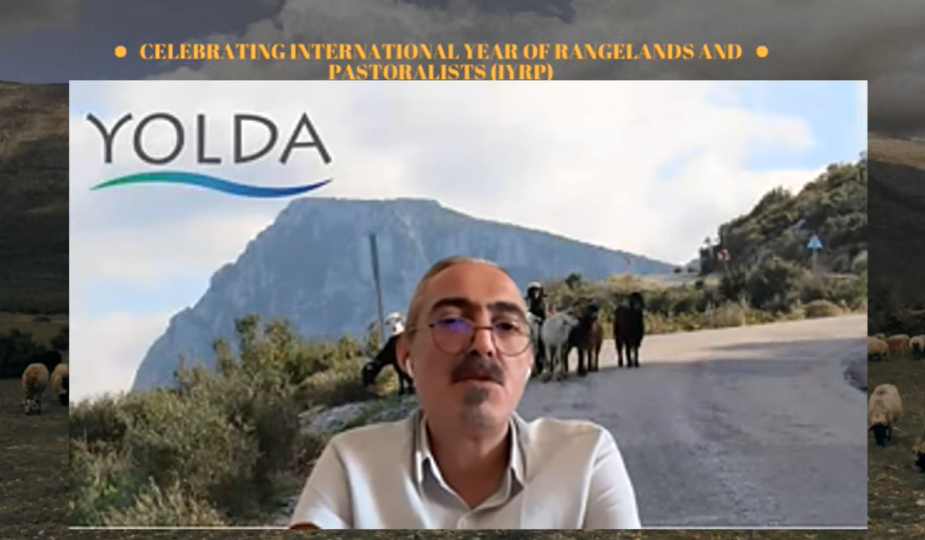
The webinar was held as part of the Mosaic of LIFE and Heart of the Dinaric Karst projects, with the aim of discussing the role of traditional pastoralism in nature conservation and the sustainable development of rural areas. The lecture was delivered by Engin Yilmaz, Founder and Executive Director of the Yolda Initiative and Coordinator of the Alliance for Mediterranean Nature and Culture. As one of the leading experts on Mediterranean landscape conservation through traditional pastoralism and a member of the leadership of the Global Alliance for Rangelands and Pastoralists, Yilmaz spoke about the challenges faced by pastoral communities today and explained why transhumance remains an important tool for nature conservation and sustainable landscape management.
A Year Dedicated to Rangelands and Pastoralists
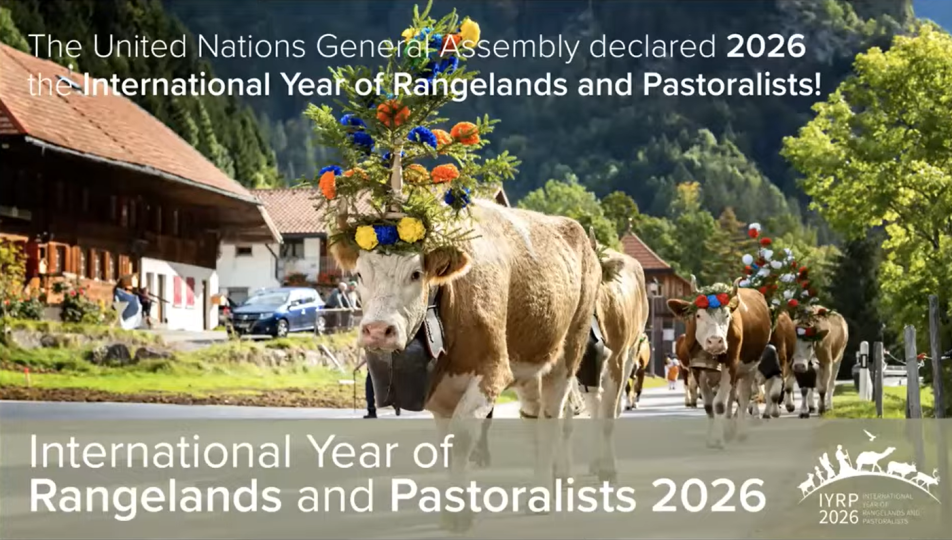
At the beginning of his presentation, Yilmaz introduced the initiative that led to the proclamation of 2026 as the International Year of Rangelands and Pastoralists. The idea originated in 2008, and after nearly two decades of collaboration among pastoralists, scientists and nature conservation organisations, the United Nations General Assembly officially designated 2026 as a year dedicated to rangelands and pastoralism.
The initiative aims to recognise the contribution of traditional pastoral communities while raising awareness of their role in biodiversity conservation, food production, climate change mitigation and the sustainable development of rural areas. It also seeks to challenge long-standing misconceptions about pastoralism and strengthen the voice of pastoralists in shaping the policies that affect their livelihoods.
One of the key messages of the presentation was that pastoralism is far from being an outdated form of livestock production. Rather, it is a complex socio-ecological system that has evolved over centuries in close harmony with natural processes. Unlike intensive livestock farming, which depends on significant inputs of feed, infrastructure and energy, transhumance follows natural vegetation cycles. Livestock move seasonally between winter and summer pastures, following the availability of forage, weather conditions and environmental changes. This mobility prevents overgrazing, allows vegetation to recover and helps maintain diverse and resilient landscapes.
Yilmaz stressed that adaptation lies at the heart of pastoralism. Every year, shepherds decide when to move their herds, which routes to follow and which pastures to use depending on rainfall, vegetation growth, animal health and other changing conditions. Such flexibility has become increasingly important in the face of climate change.
Many landscapes that we perceive today as “natural” are, in fact, the result of centuries of interaction between people and nature. Large areas of Europe’s grasslands, mountain pastures and Mediterranean open habitats have been shaped through traditional grazing practices. Pastoral communities are therefore much more than users of natural resources. Their knowledge, livestock management practices and daily work actively maintain ecosystems. As a result, the long-held belief that livestock farming and nature conservation are incompatible is gradually being replaced by growing scientific evidence showing that many of Europe’s most valuable habitats have survived precisely because of traditional grazing.
More Than Grazing: Supporting Biodiversity
The presentation offered numerous examples illustrating the ecological importance of transhumance.
Regular grazing prevents grasslands from becoming overgrown with shrubs and forests, maintaining open habitats that support a wide range of plant species, insects, pollinators and birds. As livestock move along migration routes, they naturally disperse seeds through their fur and dung, connecting distant habitats and promoting vegetation recovery and ecosystem resilience.
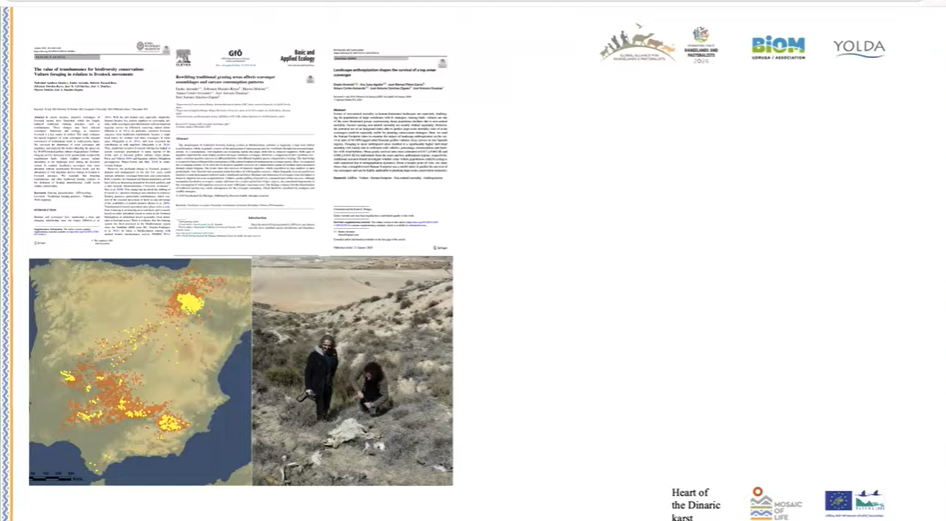
Particularly striking were the findings from research conducted in Spain, which demonstrated a clear connection between transhumance and the conservation of scavenger bird populations. Satellite tracking revealed that vultures consistently forage in areas used by transhumant herds throughout the year. Maintaining traditional grazing therefore directly contributes to the survival of these important scavengers, as well as many other species that depend on open grassland habitats.
Increasingly frequent and severe wildfires represent one of the greatest environmental challenges across the Mediterranean. This is another area where transhumance plays a vital role. Grazing removes excess dry vegetation that serves as fuel for fires, while migration routes create open corridors that can help slow the spread of flames. Rather than relying solely on costly technical interventions, these landscapes are maintained continuously through the everyday work of pastoralists. Yilmaz warned that the abandonment of traditional grazing in many parts of Europe is already leading to grassland encroachment, biodiversity loss and an increased risk of large wildfires.
Traditional Knowledge and Modern Technology Can Go Hand in Hand
One common misconception is that pastoralism rejects modern ways of life. In reality, today’s shepherds increasingly combine traditional knowledge with modern technology. They use GPS devices, satellite weather forecasts, mobile phones, electronic animal identification systems and digital tools for herd management. At the same time, many diversify their income through certified traditional products, value-added dairy and meat production, and agri-tourism.
According to Yilmaz, the real question is not whether pastoralism should become more modern, but rather how modern society can better understand and support pastoral communities. Traditional ecological knowledge and scientific knowledge are not mutually exclusive; together they provide some of the most effective solutions for nature conservation.
Although the number of transhumant farms has declined across many European countries, there are also encouraging examples. Research conducted in Spain’s Aragon region has shown that some families have returned to transhumance in recent years, while young people with no pastoral family background have also chosen to adopt this way of life. Their success has largely depended on access to grazing land, the preservation of migration routes and supportive public policies. These examples demonstrate that transhumance is far from obsolete. Under the right conditions, it remains an economically viable and sustainable form of food production.
Despite its many benefits, pastoral communities face numerous challenges. Migration routes are disappearing due to land-use changes and infrastructure development. Young people are leaving rural areas, while traditional knowledge that has been passed down orally for generations is gradually being lost. Administrative procedures and legislation are generally designed for intensive livestock farming, often overlooking the specific needs of mobile pastoralism.
Yilmaz emphasised that many public policies still treat pastoralists primarily as recipients of knowledge, rather than recognising them as equal partners who possess invaluable expertise. He argued that pastoralists should be actively involved in designing, implementing and evaluating conservation measures if transhumance is to be successfully preserved.
A key message of the webinar was the need to adapt public policies to the realities of pastoral life. This includes protecting migration corridors, improving access to grazing land, adapting education and healthcare services to mobile lifestyles, reducing administrative burdens and recognising pastoralism as a distinct form of land management within European policies. Spain was highlighted as an example of good practice, where transhumance routes are legally protected and recognised today as an important part of both the country’s green infrastructure and its cultural heritage.
In his concluding remarks, Yilmaz stressed that the future of Mediterranean landscapes cannot be separated from the people who have shaped them for centuries. Transhumance is not simply a livestock production system; it is also part of the cultural identity of many communities, a means of passing on knowledge, maintaining open habitats and adapting to environmental change. At a time when Europe is searching for sustainable responses to climate change, biodiversity loss and rural depopulation, the experience of pastoral communities offers valuable lessons that have been tested over generations.
As Yilmaz concluded, preserving pastoralism is not about romanticising the past or holding on to nostalgia. It is an investment in a more sustainable future. By protecting rangelands, we are not only conserving nature, but also safeguarding the knowledge, identity and way of life that have shaped Mediterranean landscapes for centuries. This is precisely why the International Year of Rangelands and Pastoralists provides an important opportunity to recognise transhumance once again as a valuable part of Europe’s natural and cultural heritage and as a key ally in conserving landscapes for future generations.
You can watch the full webinar at the link below: